| Location | Duration | Kenyan Cost | Non-Kenyan Cost | Upcoming Schedules |
|---|---|---|---|---|
| Nairobi, Kenya | 5 Days | KES 115,000 | USD 1,500 | Enroll |
| Kigali, Rwanda | 5 Days | USD 1,900 | USD 1,900 | Enroll |
| Kampala, Uganda | 5 Days | USD 1,900 | USD 1,900 | Enroll |
| Dar es Salaam, Tanzania | 5 Days | USD 2,000 | USD 2,000 | Enroll |
| Dubai, UAE | 5 Days | USD 3,900 | USD 3,900 | Enroll |
| Abuja, Nigeria | 5 Days | USD 4,000 | USD 4,000 | Enroll |
| Accra, Ghana | 5 Days | USD 4,000 | USD 4,000 | Enroll |
| Pretoria, South Africa | 5 Days | USD 3,900 | USD 3,900 | Enroll |
| Start & End Date | Duration | Kenyan Cost | Non-Kenyan Cost | Enroll | |
|---|---|---|---|---|---|
| Sep 14–Sep 22, 2026 | 7 Days | KES 180,000 | USD 2,000 | Register | |
| Sep 28–Oct 06, 2026 | 7 Days | KES 90,000 | USD 1,000 | Register | |
| Oct 12–Oct 20, 2026 | 7 Days | KES 90,000 | USD 1,000 | Register | |
| Oct 26–Nov 03, 2026 | 7 Days | KES 90,000 | USD 1,000 | Register | |
| Nov 09–Nov 17, 2026 | 7 Days | KES 90,000 | USD 1,000 | Register | |
| Nov 23–Dec 01, 2026 | 7 Days | KES 90,000 | USD 1,000 | Register | |
| Dec 07–Dec 15, 2026 | 7 Days | KES 90,000 | USD 1,000 | Register | |
| Dec 21–Dec 29, 2026 | 7 Days | KES 90,000 | USD 1,000 | Register | |
| Jan 04–Jan 12, 2027 | 7 Days | KES 90,000 | USD 1,000 | Register | |
| Jan 18–Jan 26, 2027 | 7 Days | KES 90,000 | USD 1,000 | Register | |
| Feb 01–Feb 09, 2027 | 7 Days | KES 90,000 | USD 1,000 | Register | |
| Feb 15–Feb 23, 2027 | 7 Days | KES 90,000 | USD 1,000 | Register | |
| Mar 01–Mar 09, 2027 | 7 Days | KES 90,000 | USD 1,000 | Register | |
| Mar 15–Mar 23, 2027 | 7 Days | KES 90,000 | USD 1,000 | Register | |
| Mar 29–Apr 06, 2027 | 7 Days | KES 90,000 | USD 1,000 | Register | |
| Apr 12–Apr 20, 2027 | 7 Days | KES 90,000 | USD 1,000 | Register | |
| Apr 26–May 04, 2027 | 7 Days | KES 90,000 | USD 1,000 | Register | |
| May 10–May 18, 2027 | 7 Days | KES 90,000 | USD 1,000 | Register | |
| May 24–Jun 01, 2027 | 7 Days | KES 90,000 | USD 1,000 | Register | |
| Jun 07–Jun 15, 2027 | 7 Days | KES 90,000 | USD 1,000 | Register | |
| Jun 21–Jun 29, 2027 | 7 Days | KES 90,000 | USD 1,000 | Register | |
| Jul 05–Jul 13, 2027 | 7 Days | KES 90,000 | USD 1,000 | Register | |
| Jul 19–Jul 27, 2027 | 7 Days | KES 90,000 | USD 1,000 | Register | |
| Aug 02–Aug 10, 2027 | 7 Days | KES 90,000 | USD 1,000 | Register | |
About the Course
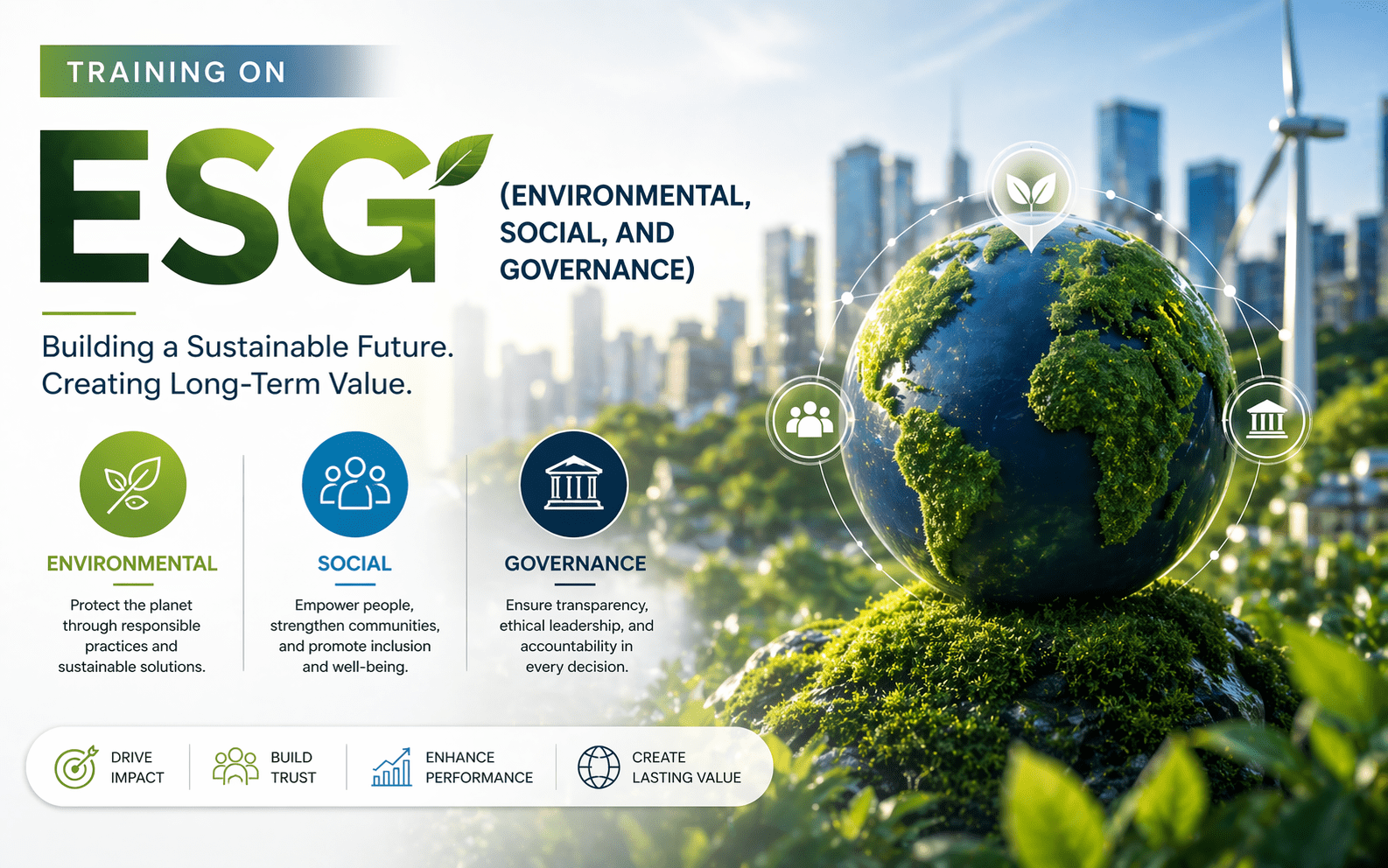
Environmental, Social, and Governance (ESG) considerations have become essential pillars of financial strategy, investment planning, and corporate risk management. As global standards shift toward sustainable corporate practices, organizations must integrate ESG principles into their financial frameworks to strengthen risk resilience, attract investment, improve stakeholder trust, ensure regulatory compliance, and support long-term value creation. Corporate finance teams increasingly play a central role in embedding ESG priorities into budgeting, forecasting, reporting, capital allocation, and strategic planning.
This course provides a comprehensive understanding of ESG frameworks, sustainable finance principles, environmental and social risk assessment techniques, ESG data analytics, sustainability reporting standards, impact measurement, and corporate finance strategies that align sustainability with financial performance. Participants will explore global best practices, regulatory developments, integrated reporting frameworks, and ESG investment trends shaping modern corporate finance.
By the end of the course, participants will be equipped to design, implement, and evaluate ESG-aligned financial strategies that support sustainable business transformation, long-term competitiveness, and improved organizational transparency.
Target Participants
This course is ideal for corporate finance professionals, sustainability managers, ESG analysts, investment officers, risk managers, CFOs, auditors, project managers, CSR teams, corporate strategists, and anyone responsible for integrating sustainability considerations into financial decision-making and organizational strategy.
What You Will Learn
By the end of this course the participants will be able to:
- Understand ESG concepts, global standards, and sustainability frameworks
- Integrate ESG risks into corporate financial planning and decision-making
- Evaluate ESG performance using data-driven tools and metrics
- Apply ESG principles in budgeting, forecasting, and capital allocation
- Assess environmental and social risks affecting financial outcomes
- Align corporate finance with international ESG reporting standards
- Strengthen accountability and governance through ESG strategies
- Prepare ESG-integrated financial reports
Course Duration
- Classroom – 5 Days
- Online – 7 Days
Course Outline
Introduction to Corporate ESG Finance
- Evolution of ESG in corporate finance
- ESG relevance for financial performance and investor confidence
- Linking ESG to long-term enterprise value
- Overview of global sustainability trends
- ESG expectations for corporate leadership
ESG Frameworks for Corporate Finance
- Overview of ESG frameworks (UN Global Compact, SDGs, TCFD, UN PRI)
- Understanding ESG pillars
- Industry-specific ESG considerations
- Drivers of ESG adoption
- Aligning corporate finance with global ESG frameworks
Environmental Risk Assessment Techniques
- Identifying environmental risks in corporate operations
- Evaluating climate-related financial exposure
- Physical vs transition risk
- Environmental performance indicators
- Tools for environmental impact assessment
Social Impact Assessment for Finance
- Identifying social risks in value chains and operations
- Labor standards, community impacts, and human rights issues
- Social performance metrics
- Assessing socio-economic externalities
- Integrating social priorities into financial plans
ESG Data Analysis Tools
- ESG data sources for corporate finance teams
- Using data analytics to score ESG performance
- Identifying red flags and ESG performance gaps
- ESG dashboards and visualization tools
- Data quality assurance techniques
ESG-Integrated Budgeting Practices
- Incorporating ESG objectives into departmental budgets
- Green cost centers and sustainability-focused budget lines
- Budget trade-offs influenced by ESG priorities
- Funding ESG initiatives within budget cycles
- Linking ESG indicators to resource allocation
ESG-Informed Capital Allocation
- Integrating ESG considerations into capital expenditure planning
- Prioritizing sustainable investment projects
- Screening investments using ESG criteria
- Evaluating long-term financial returns of ESG initiatives
- Cost-benefit perspectives for ESG expenditures
Sustainable Investment Instruments
- ESG bonds, sustainability-linked loans, green credit facilities
- Impact investment opportunities
- Screening tools for sustainable portfolios
- Market trends in sustainable corporate finance
- Certification and verification of sustainable instruments
Governance Structures for ESG Finance
- Board oversight of sustainability issues
- ESG mandates for finance committees
- Governance mechanisms supporting ESG performance
- Internal controls for sustainability-related finances
- Stakeholder engagement in ESG governance
Reporting Techniques for ESG Performance
- Preparing ESG-integrated financial reports
- Understanding GRI, SASB, ISSB, and integrated reporting
- Communicating ESG value to stakeholders
- Aligning disclosures with investor expectations
- Producing audit-ready ESG data
Training Approach
This course is delivered by our seasoned trainers who have vast experience as expert professionals in their respective fields of practice. The course is taught through a mix of practical activities, presentations, group works and case studies.
Training notes and additional reference materials are provided to the participants.
Certification
Upon successful completion of this course, participants will be issued a certificate.
Tailor-Made Course
We can also do this as a tailor-made course to meet organization-wide needs.